Session A1
Speaker: Dion Mann (UConn)
(11:30 am-12 pm, MONT 225)
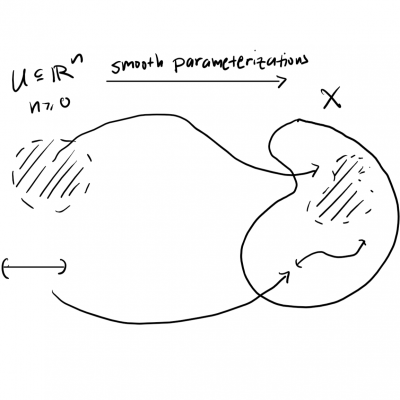
Diffeology: A Smooth Analogue of Topology
Abstract: The theory of diffeology emerged arounds the 80s due to Jean-Marie Souriau, which is still in development today (mostly led by Souriau's former student, Patrick Iglesias-Zemmour). A diffeology on a set is a certain, abstract smooth structure which is comprised of functions which one wants to consider "smooth." We present the basic ideas of diffeology and discuss how differential geometry naturally emerges from this more general structure. No background information in geometry or topology is assumed!
Session A2:

Speaker: Yeorgia Kafkoulis (UConn)
(12:00-12:30 pm, MONT 225)
The Geometry of Black Holes
Abstract: Black Holes are physical objects that saturate our universe.They are found at nearly every center of every galaxy. While they are objects of physical importance, they are also fascinating mathematically. In this talk, we will explore the basics of black holes, their geometry, and a few fundamental theorems that classify their behavior.
Removing Limits from Calculus: A Discrete Approach
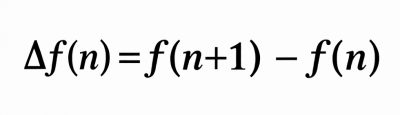
Abstract: Have you ever thought that limits are the worst part of calculus? Ever wanted to remake calculus in a way that avoids limits entirely? Well now you can! In this talk, we will develop an analogue of ordinary calculus for sequences instead of functions. Our main tool: finite differences. Using this tool, we will prove discrete analogues of many theorems including the Fundamental Theorem of Calculus. Finally, we will apply our newly developed techniques to find “nice” formulas for common partial sum expressions.
Session B1:
Speaker: Caylee Spivey (UConn)
(11:30 am-12:00 pm, MONT 226)
Arithmetic Ramsey Theory
Abstract: Broadly, Ramsey theory is the study of the emergence of “order” in seemingly random structures of sufficiently large size. Frank Ramsey’s now-famous theorem is a prime example: for any positive integer n, any graph with enough vertices must contain either a clique of size n or an independent set of size n. Classical results—such as Van der Waerden’s theorem and Szemerédi’s theorem—together with more recent breakthroughs like the Green–Tao theorem, showcase this phenomenon in an arithmetic setting.
Session B2:

Speaker: Oscar Quester (UConn)
(12:00 - 12:30 pm, MONT 226)
Session A3:
Speaker: Sean Lyon (UConn)
(2:30-3:00 pm, MONT 225)
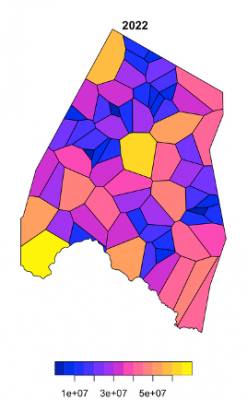
Territorial Geometries of Hornbills in Southern Africa
Abstract: A long history of applying mathematical principles to the fields of ecology and evolution has generated robust interdisciplinary scholarship. I build on this history to address the evolution of sociality, adapting Voronoi neighborhood mathematics to understand territorial dynamics in endangered birds. Based on my analysis of two decades of aerial survey data, I will share what we have learned from looking at a population recovering from low density exploring how density mediates social dynamics. Broadly, this talk will inspire new perspectives on the interactions between mathematics and biology.
Session A4:
Speaker: Garett Cunningham (UConn)
(3:00-3:30 pm, MONT 225)
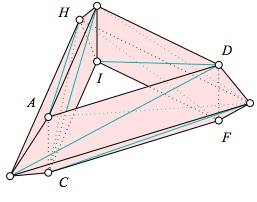
How Complex Is a Simplicial Complex?
Abstract: Simplicial complexes are a useful tool from topology that turn geometric problems into purely combinatorial ones, hence making them much easier to compute. The study of these objects started simple with 3-dimensional polyhedra. However, making our way into higher dimensions, we quickly find that these objects are quite complex. In particular, since these objects exist to make computations more viable, one might ask: just how much can we compute and how easily? We'll take a look at simplicial complexes through the lens of computability theory, which focuses on studying questions about when problems are actually solvable algorithmically, and more importantly why most problems are not. In particular, we will study how hard it is to determine properties of a simplicial complex.
Geodesics and applications of the Cut Locus
Abstract: Due to the spherical geometry of the globe, if four travelers took off from the same location in four different directions, all at the same speed, following “geodesic” paths, they would all meet up again exactly at the antipodal point of wherever they started. If we started here in Storrs, Connecticut, we would end up several hundred miles off the western coast of Australia, in the middle of the ocean. This is a rudimentary example of the computation of the “cut locus” in geometry, or the set of points where geodesic paths cease to be strictly optimal.
Session B3:
Speaker: Michael Albert (UConn)
(2:30-3:00 pm, MONT 226)
Graph Coloring
Abstract: In this talk, I will talk about an interesting area of mathematics and computer science, called Graph Theory. I will be specifically talking about Graph Coloring. I will give some basic terminology, an algorithm for finding a coloring of a graph, give a criterion for checking if a graph can be colored using only 2 colors, and go through a real-world example of how graph coloring can be used to schedule meetings.
Session B4:
Speaker: Swati Gaba (UConn)
(3:00-3:30 pm, MONT 226)